
Skip to main content Skip to footer

Articles and Downloads

Learn more from our Downloads and read our Articles on 
Data Asset Foundations

Downloads

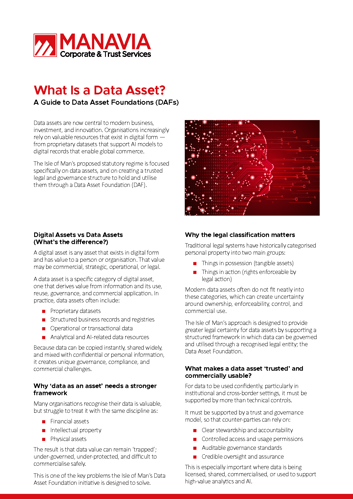
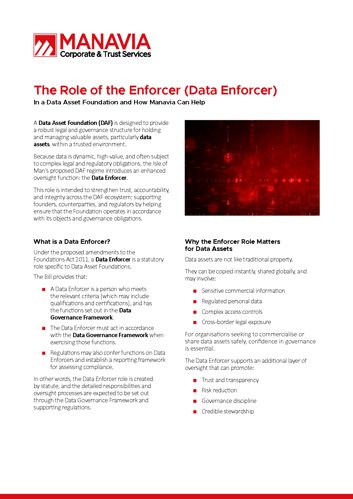
What is a Data Asset? < Download and read What is a Data Asset? here. The Role of the Enforcer < Download and read about The Role of the Enforcer here.             

Articles

What Is a Data Asset?

A Guide to Data Asset Foundations (DAFs)

Data assets are now central to modern business, investment, and innovation. Organisations increasingly rely on valuable resources that exist in digital form — from proprietary datasets that support AI models to digital records that enable global commerce.

The Isle of Man’s proposed statutory regime is focused specifically on data assets, and on creating a trusted legal and governance structure to hold and utilise them through a Data Asset Foundation (DAF).

Read more...

Digital Assets vs Data Assets (What’s the difference?)
A digital asset is any asset that exists in digital form and has value to a person or organisation. That value may be commercial, strategic, operational, or legal.

A data asset is a specific category of digital asset, one that derives value from information and its use, reuse, governance, and commercial application. In practice, data assets often include:

    • Proprietary datasets
    • Structured business records and registries
    • Operational or transactional data
    • Analytical and AI-related data resources

Because data can be copied instantly, shared widely, and mixed with confidential or personal information, it creates unique governance, compliance, and commercial challenges.

Why ‘data as an asset’ needs a stronger framework
Many organisations recognise their data is valuable, but struggle to treat it with the same discipline as:

    • Financial assets
    • Intellectual property
    • Physical assets

The result is that data value can remain ‘trapped’; under-governed, under-protected, and difficult to commercialise safely.

This is one of the key problems the Isle of Man’s Data Asset Foundation initiative is designed to solve.

Why the legal classification matters
Traditional legal systems have historically categorised personal property into two main groups:

    • Things in possession (tangible assets)
    • Things in action (rights enforceable by
      legal action)

Modern data assets often do not fit neatly into these categories, which can create uncertainty around ownership, enforceability, control, and commercial use.

The Isle of Man’s approach is designed to provide greater legal certainty for data assets by supporting a structured framework in which data can be governed and utilised through a recognised legal entity; the Data Asset Foundation.

What makes a data asset ‘trusted’ and commercially usable?
For data to be used confidently, particularly in institutional and cross-border settings, it must be supported by more than technical controls.

It must be supported by a trust and governance model, so that counter-parties can rely on:

    • Clear stewardship and accountability
    • Controlled access and usage permissions
    • Auditable governance standards
    • Credible oversight and assurance

This is especially important where data is being licensed, shared, commercialised, or used to support high-value analytics and AI.

How a Data Asset Foundation (DAF) supports data assets
A DAF is a type of Isle of Man foundation designed to hold and utilise data assets within a regulated and trusted framework.

In the Isle of Man regime, ‘data asset’ is a defined legal concept and refers to data that has been formally dedicated and fully registered through the statutory process.

In summary, the proposed DAF regime is designed so that:

    • ‘Data’ is broadly understood as a digital representation of acts, facts or information, including compilations and recordings.
    • A ‘data asset’ becomes something formally dedicated and registered, becoming a fully registered data asset under the statutory process.
    • Once fully registered, a personal property right is vested in the Data Asset Foundation, even though the asset may be neither a “thing in possession” nor a “thing in action”.

This creates a powerful foundation for organisations seeking legal certainty and governance confidence around high-value data assets.

How Manavia helps clients establish and operate Data Asset Foundations
Manavia is a licensed Trust and CorporateService Provider (TCSP) based in the Isle of Man, delivering trusted fiduciary and corporate solutions for global clients.

We support clients who want to:

    • Establish a Data Asset Foundation and implement the full governance structure.
    • Protect long-term value and commercial usability of data assets.
    • Put in place robust oversight, including Council and Enforcer support.
    • Access specialist legal drafting and advice as part of a complete service.

Manavia provides:

    • Foundation formation and administration.
    • Council and Enforcer services.
    • Fiduciary oversight and governance support.
    • Legal and regulatory integration through MannBenham Advocates, enabling drafting and specialist advice as part of a complete service.

This combined fiduciary + legal capability is a key differentiator: clients benefit from a seamless, expert service from structuring through to documentation, governance, and ongoing administration.

Next Steps
If you are exploring how to hold, govern, and commercialise data assets through a trusted structure, Manavia can guide you through the establishment and operation of a Data Asset Foundation and the oversight services that support it.

Written by Miles Benham
The Role of the Enforcer

And How Manavia Can Help

A Data Asset Foundation (DAF) is designed to provide a robust legal and governance structure for holding and managing valuable assets, particularly data assets, within a trusted environment.

Because data is dynamic, high-value, and often subject to complex legal and regulatory obligations, the Isle of Man’s proposed DAF regime introduces an enhanced oversight function: the Data Enforcer.

Read more...

This role is intended to strengthen trust, accountability, and integrity across the DAF ecosystem; supporting founders, counterparties, and regulators by helping ensure that the Foundation operates in accordance with its objects and governance obligations.

What is a Data Enforcer?
Under the proposed amendments to the Foundations Act 2011, a Data Enforcer is a statutory role specific to Data Asset Foundations.

The Bill provides that:

    • A Data Enforcer is a person who meets the relevant criteria (which may include qualifications and certifications), and has 
      the functions set out in the Data 
      Governance Framework.
    • The Data Enforcer must act in accordance with the Data Governance Framework when exercising those functions.
    • Regulations may also confer functions on Data Enforcers and establish a reporting framework for assessing compliance.

In other words, the Data Enforcer role is created by statute, and the detailed responsibilities and oversight processes are expected to be set out through the Data Governance Framework and supporting regulations.

Why the Enforcer Role Matters for Data Assets
Data assets are not like traditional property.

They can be copied instantly, shared globally, and may involve:

    • Sensitive commercial information
    • Regulated personal data
    • Complex access controls
    • Cross-border legal exposure

For organisations seeking to commercialise or share data assets safely, confidence in governance is essential.

The Data Enforcer supports an additional layer of oversight that can promote:

    • Trust and transparency
    • Risk reduction
    • Governance discipline
    • Credible stewardship

The Data Enforcer’s Core Function:
Specialist Oversight

The Data Enforcer is intended to operate as an oversight role, distinct from day-to-day management.

The Council manages the Foundation
The DAF’s Council is responsible for the Foundation’s management and decision-making.

The Data Enforcer supports oversight 
and accountability
The Data Enforcer helps ensure that the DAF operates in accordance with:

    • Its objects;
    • Its governance requirements;
    • The Data Governance Framework.

The Bill specifically requires the Council of the Data Asset Foundation to cooperate with and provide reasonable assistance to the Data Enforcer to enable the Data Enforcer to carry out its functions.

This is a critical feature: the Data Enforcer is not merely a symbolic role. The DAF must support the Data Enforcer in practice.

Information and Reporting: 
Interaction with the Data Asset Registrar
The Bill provides that information received from the Data Asset Foundation by the Data Enforcer may be disclosed to the Data Asset Registrar in the performance of its functions under the Act.

This supports the integrity of the overall DAF system, including the registration and oversight of data assets.

How the Data Enforcer Role Works in Practice
While the Bill establishes the Data Enforcer role, the detailed operational mechanics will be shaped by:

    • The Data Governance Framework, which regulations must establish
    • Any further requirements and functions set by regulations

In practice, a well-run Data Enforcer function is likely to support:

    • Governance oversight and assurance coordination.
    • Compliance monitoring aligned to the DAF framework.
    • Review of issues and remediation actions where risks arise.
    • Structured reporting and accountability mechanisms.

This provides comfort not only to the founder and the Council, but also to commercial partners who need confidence in how data assets are being governed.

How Manavia Can Help
Manavia is a licensed trust and corporate service provider based in the Isle of Man, supporting clients who want a complete, professionally governed Data Asset Foundation (DAF) solution.

We assist clients not only with the Data Enforcer function, but also with the establishment, structuring, and ongoing administration of Data Asset Foundations. Setting up a DAF is not simply a matter of incorporation — it requires a structure that is coherent, operationally workable, and capable of supporting long-term governance and compliance obligations.

Manavia can support clients from the earliest stage of planning and setup, including coordinating the formation of the Foundation, establishing the governance structure, and ensuring the DAF is operationally ready. We help clients implement clear processes and documentation standards so that the Council can manage the Foundation efficiently and in line with its objects and applicable governance requirements.

Once the Foundation is established, Manavia can provide ongoing administration and governance support, including maintaining records, supporting Council decision-making processes, and ensuring that the DAF remains properly managed over time. We can also assist with coordinating external professional parties involved in the DAF ecosystem, including assurance and specialist advisory services, so that the structure operates smoothly and credibly for counterparties and stakeholders.

Where Manavia acts as Data Enforcer, we provide the specialist oversight function contemplated by the regime, supporting trust, accountability, and governance integrity in a structured and professional manner.

Manavia forms part of MannBenham Advocates, giving clients access to expert lawyers who can provide a complete end-to-end service, including:

    • Drafting and reviewing foundation rules and governance provisions
    • Advising on governance structures and compliance requirements
    • Supporting complex structuring and commercial arrangements involving data assets
    • Ensuring documentation aligns with Isle of Man requirements and international expectations

This integrated fiduciary and legal capability is a key differentiator for clients seeking a serious, institutional-grade solution.

Speak to Manavia About Enforcer Services
If you are considering establishing a Data Asset Foundation, or you want to understand how the Data Enforcer role should be structured in practice, Manavia can guide you through the process from start to finish.

Contact Manavia today to discuss establishing a Data Asset Foundation, governance support, and Data Enforcer services.

Written by Miles Benham

How can Manavia help?

Manavia Limited is a licensed trust and corporate service provider based in the Isle of Man.

We support clients seeking to establish and operate Data Asset Foundations, including:

DAF formation and administration support
We assist with structuring, establishment and ongoing governance support.

Data Enforcer services
Manavia can act as the Data Enforcer, providing the specialist oversight function contemplated by the regime, supporting governance integrity and trusted operation.

A complete service with MannBenham Advocates
Manavia forms part of MannBenham Advocates, providing clients access to expert lawyers for a complete service including drafting, specialist advice and documentation support.


Note:
The Data Asset Foundation regime is subject to legislation, regulations and the Data Governance Framework as implemented and in force from time to time. Manavia can advise on current requirements and assist with structuring and ongoing support.

Get in touch today to discuss your requirements

Contact Manavia Today

10-12 Victoria Street, Douglas, Isle of Man, IM1 2LH | Email: info@manavia.im | Telephone: +44 (0)1624 639350


Have questions or need guidance?

Reach out to our friendly team today and let's discuss how we can support your vision.


Email:
  info@manavia.im

Phone Number: +44 (0)1624 639350

Address: 10-12 Victoria Street, Douglas, Isle of Man, IM1 2LH


Manavia Limited is a company registered in the Isle of Man  with Company number 88712C and is licensed by the Isle of Man Financial Services Authority to provide Corporate and Trust Services.

© 2025 Manavia Limited | Privacy Notice | Cookie Notice | Legal Notice